Understanding the intricate differences between Artificial Intelligence (AI), Machine Learning (ML), and Deep Learning (DL) is crucial for navigating the rapidly evolving technological landscape. This guide provides a structured approach to demystifying these interconnected concepts, exploring their unique characteristics, applications, and future implications.
From foundational definitions to practical applications, we’ll delve into the specifics of each technology, highlighting their distinct features and relationships. The exploration will include detailed comparisons, illustrative examples, and a clear roadmap for understanding the differences between AI, ML, and DL.
Defining the Core Concepts

Understanding the nuances between Artificial Intelligence (AI), Machine Learning (ML), and Deep Learning (DL) is crucial for comprehending their distinct capabilities and applications. These fields, while interconnected, represent different levels of sophistication in computer systems’ ability to mimic human intelligence. This section will delve into the core definitions of each, highlighting their fundamental principles and how they relate to one another.
Defining Artificial Intelligence (AI)
Artificial intelligence (AI) encompasses the broad concept of creating intelligent agents, which are systems capable of performing tasks that typically require human intelligence. These tasks include learning, problem-solving, decision-making, and understanding language. AI systems can be rule-based, relying on explicit programming, or data-driven, employing techniques like machine learning.
Defining Machine Learning (ML)
Machine learning (ML) is a subset of AI that focuses on enabling computer systems to learn from data without being explicitly programmed. Instead of relying on predefined rules, ML algorithms identify patterns and relationships within data to make predictions or decisions. A fundamental principle of ML is the use of algorithms to improve performance over time based on the data they process.
For instance, a spam filter learns to identify spam emails by analyzing numerous examples of spam and non-spam messages.
Defining Deep Learning (DL)
Deep learning (DL) is a specialized subset of machine learning that utilizes artificial neural networks with multiple layers (hence “deep”). These networks learn complex patterns and representations from data, enabling them to perform tasks such as image recognition, natural language processing, and speech recognition. The ability of deep learning models to automatically extract features from raw data is a key advantage.
For example, a deep learning model can identify objects in an image without being explicitly told what to look for.
Comparing AI, ML, and DL
| Concept | Definition | Key Characteristics |
|---|---|---|
| Artificial Intelligence (AI) | The broad concept of creating intelligent agents capable of performing tasks requiring human intelligence. | Encompasses various approaches, including rule-based and data-driven methods. |
| Machine Learning (ML) | A subset of AI that enables systems to learn from data without explicit programming. | Algorithms identify patterns and relationships to make predictions or decisions; performance improves over time based on data processed. |
| Deep Learning (DL) | A specialized subset of machine learning that utilizes artificial neural networks with multiple layers. | Automatically extracts features from raw data to perform complex tasks; excels in tasks requiring high-level pattern recognition. |
Distinguishing Features
Artificial intelligence (AI), machine learning (ML), and deep learning (DL) are closely related but distinct fields. Understanding their unique characteristics is crucial for choosing the appropriate approach for a specific task. This section will delve into the differentiating features of these methodologies, focusing on their learning approaches, data requirements, algorithmic complexity, and the level of human intervention involved.
Learning Approaches
The fundamental difference lies in how each field learns. AI is the overarching umbrella term encompassing various problem-solving methods. Machine learning, a subset of AI, focuses on algorithms that enable systems to learn from data without explicit programming. Deep learning, a further specialization of machine learning, employs artificial neural networks with multiple layers to extract intricate patterns from complex data.
This layered approach allows deep learning models to identify intricate relationships within data that would be missed by simpler methods.
Data Types
The type of data used significantly impacts the applicability of each method. AI systems can utilize structured, unstructured, or semi-structured data. Machine learning algorithms thrive on various data types, including numerical, categorical, and textual data. Deep learning models excel at handling large volumes of unstructured data, such as images, audio, and video, and require substantial amounts of high-quality data for effective training.
Algorithm Complexity
The complexity of algorithms used in each field increases progressively. AI encompasses a wide range of algorithms, from simple rule-based systems to more complex statistical methods. Machine learning algorithms are often more sophisticated, incorporating techniques like regression, classification, and clustering. Deep learning algorithms are the most intricate, involving multi-layered neural networks with numerous parameters to be tuned.
Human Intervention
The level of human intervention required also varies. AI systems may require significant human input for designing the logic and rules, and choosing appropriate algorithms. Machine learning often involves human intervention in data preprocessing, feature engineering, and model selection. Deep learning models, due to their complexity, demand significant computational resources and careful tuning by experts.
Comparison Table
| Feature | AI | ML | DL |
|---|---|---|---|
| Learning Approach | Rule-based, knowledge-based, or statistical methods | Algorithms that learn from data without explicit programming | Artificial neural networks with multiple layers |
| Data Types | Structured, unstructured, or semi-structured data | Numerical, categorical, and textual data | Large volumes of unstructured data (images, audio, video) |
| Algorithm Complexity | Simple to complex | Moderate complexity | High complexity |
| Human Intervention | High | Moderate | High |
Applications and Examples
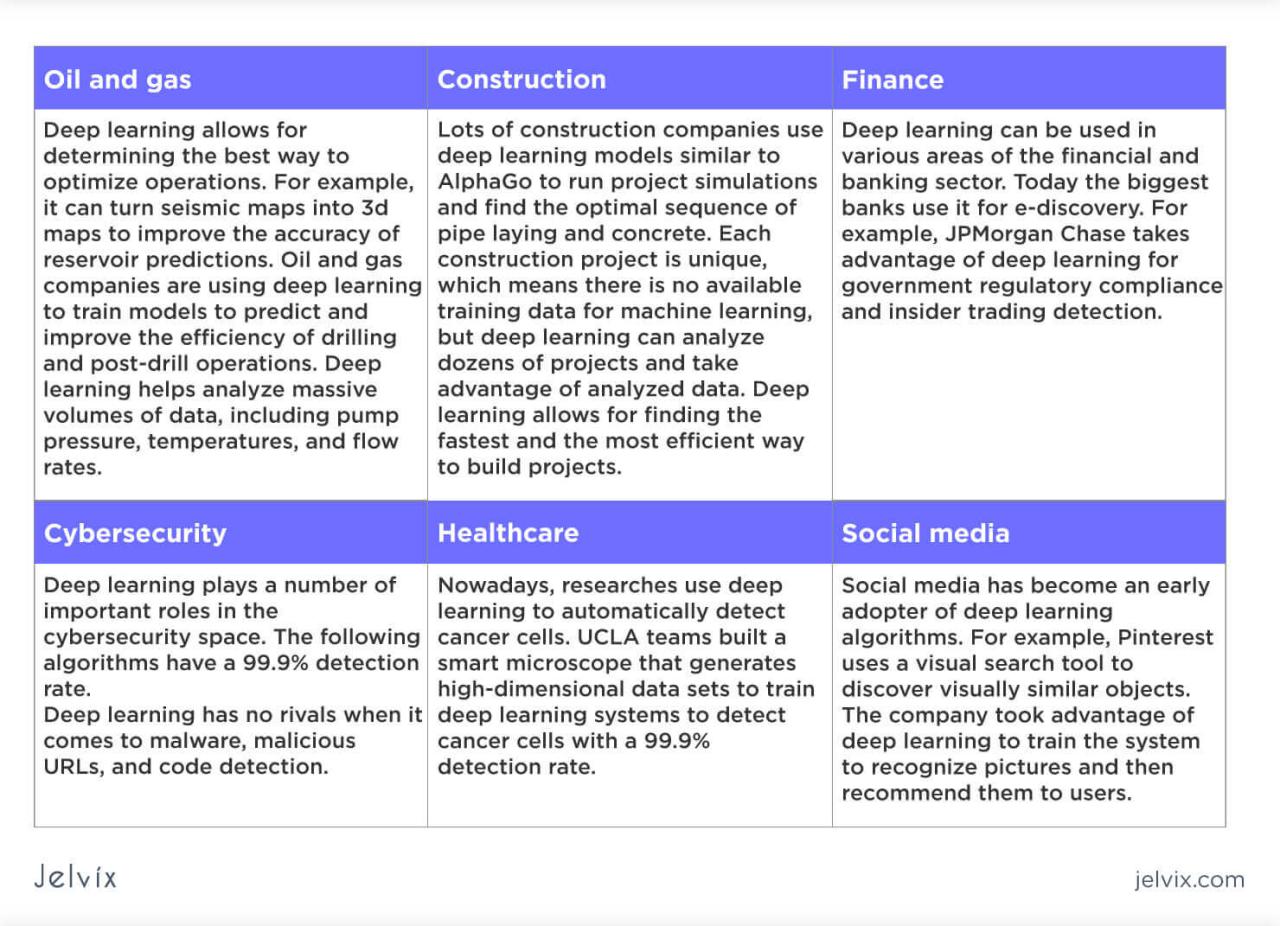
AI, machine learning, and deep learning are rapidly transforming various industries. These technologies are increasingly being deployed to automate tasks, improve decision-making, and enhance human capabilities. Understanding their diverse applications provides valuable insight into the practical impact of these advancements.These technologies, each with its unique strengths, find application in a wide range of sectors. AI, encompassing the broader concept, encompasses machine learning and deep learning as tools.
Machine learning, with its algorithms, enables systems to learn from data, while deep learning, a specialized subset of machine learning, uses artificial neural networks to extract complex patterns from vast datasets.
AI Applications Across Domains
AI is being integrated into numerous domains to improve efficiency and effectiveness. Examples include:
- Healthcare: AI-powered diagnostic tools are assisting doctors in identifying diseases earlier and more accurately. AI algorithms can analyze medical images, such as X-rays and CT scans, to detect anomalies and provide support for diagnoses. AI also helps manage patient records, predict treatment outcomes, and personalize therapies.
- Finance: AI is revolutionizing financial services, enabling fraud detection, risk assessment, and algorithmic trading. AI-powered chatbots are providing customer support and assisting with financial transactions.
- Manufacturing: AI is optimizing production processes, improving quality control, and predicting equipment failures. Predictive maintenance reduces downtime and minimizes the cost of repairs. AI-powered robots can perform complex tasks, improving efficiency and productivity.
- Customer Service: AI-powered chatbots are automating customer service interactions, answering questions, and resolving issues promptly. These systems can process large volumes of customer inquiries and improve response times.
Machine Learning Applications in Different Sectors
Machine learning algorithms are proving invaluable in numerous sectors, enabling systems to learn from data and improve performance over time. Examples include:
- Retail: Machine learning algorithms are used for personalized recommendations, inventory management, and targeted advertising. Predictive modeling helps anticipate customer demand and optimize pricing strategies.
- E-commerce: Machine learning powers search results, product recommendations, and fraud detection systems. Algorithms analyze user behavior to personalize the shopping experience.
- Transportation: Machine learning is improving logistics, optimizing routes, and enhancing traffic flow. Self-driving cars rely on machine learning algorithms for navigation and decision-making.
- Agriculture: Machine learning is improving crop yields by analyzing soil conditions, predicting weather patterns, and optimizing irrigation schedules. This leads to improved resource management and enhanced productivity.
Deep Learning Applications in Specific Fields
Deep learning, with its ability to extract complex patterns from large datasets, has significant applications in specific fields. Examples include:
- Image Recognition: Deep learning algorithms are used for facial recognition, object detection in images, and medical image analysis. This is widely used in security systems, autonomous vehicles, and medical diagnostics.
- Natural Language Processing (NLP): Deep learning models are revolutionizing NLP applications, enabling machines to understand and generate human language. Applications include machine translation, chatbots, and sentiment analysis.
- Speech Recognition: Deep learning algorithms are improving speech recognition accuracy, enabling more natural and seamless interaction between humans and machines. This technology powers voice assistants and dictation software.
- Gaming: Deep learning is being used to create more intelligent and challenging game AI. Algorithms can learn game strategies and adapt to player behavior, enhancing the gaming experience.
Diverse Applications of AI, ML, and DL
The table below illustrates the diverse applications of AI, machine learning, and deep learning across various industries.
| Industry | AI | Machine Learning | Deep Learning |
|---|---|---|---|
| Healthcare | Diagnosis support, personalized medicine | Predictive modeling of disease progression, drug discovery | Image analysis for early disease detection, medical image segmentation |
| Finance | Fraud detection, risk assessment | Algorithmic trading, customer segmentation | Algorithmic trading, fraud detection, risk assessment (complex patterns) |
| Retail | Personalized recommendations, customer service chatbots | Inventory management, demand forecasting | Product recommendations, image-based product search |
| Manufacturing | Process optimization, predictive maintenance | Quality control, predictive maintenance | Defect detection, process optimization (complex data) |
| Transportation | Autonomous vehicles, traffic optimization | Route optimization, logistics management | Self-driving cars, object detection in autonomous systems |
Relationships and Overlaps
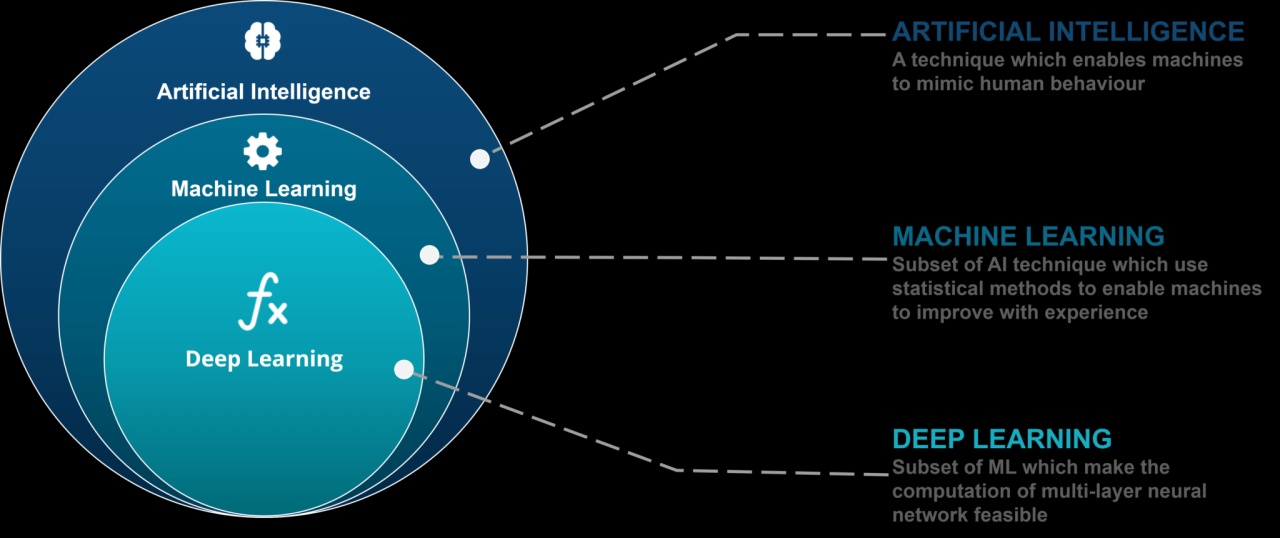
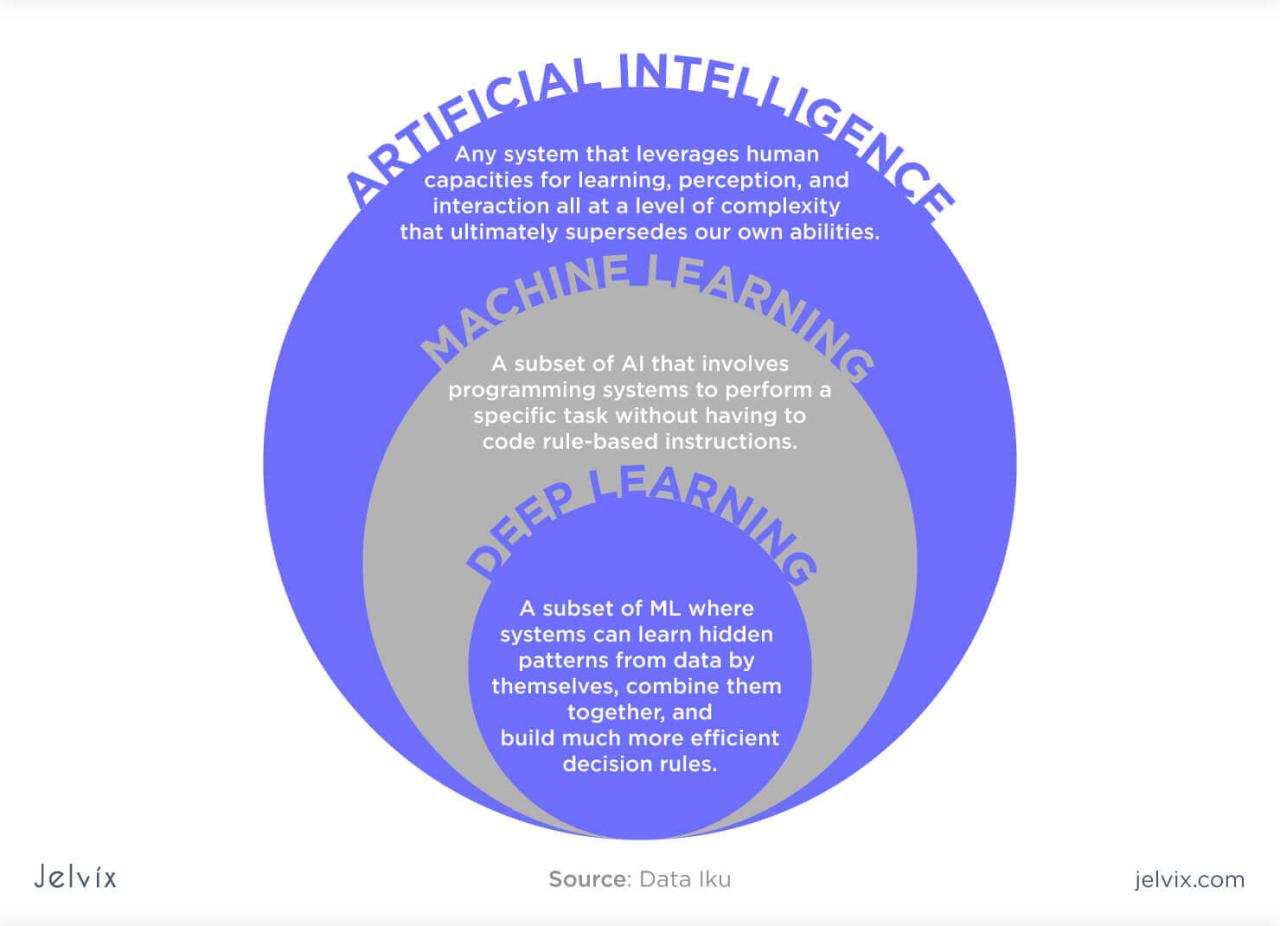
Artificial intelligence (AI), machine learning (ML), and deep learning (DL) are interconnected concepts, forming a hierarchical relationship where DL is a specialized subset of ML, and ML is a subset of AI. Understanding these relationships is crucial for grasping the capabilities and limitations of each field.
The Hierarchical Relationship
The relationships between AI, ML, and DL can be visualized as a hierarchy. AI is the broadest concept, encompassing the creation of intelligent agents that can mimic human cognitive functions. ML is a specific approach within AI that focuses on enabling machines to learn from data without explicit programming. Deep learning, in turn, is a specialized subset of ML that leverages artificial neural networks with multiple layers to extract complex patterns from data.
This hierarchical structure highlights the increasing specificity and complexity as one moves from AI to DL.
Deep Learning as a Subset of Machine Learning
Deep learning is a specialized type of machine learning algorithm. It utilizes artificial neural networks with multiple layers, often referred to as “deep” neural networks. These networks are trained on vast datasets to identify complex patterns and relationships. Deep learning excels at tasks such as image recognition, natural language processing, and speech recognition, often outperforming other machine learning approaches in these domains.
For instance, deep learning models are commonly used in self-driving cars to recognize objects and make decisions in real-time.
Machine Learning as a Subset of Artificial Intelligence
Machine learning is a core component of artificial intelligence. It empowers machines to learn from data, improving their performance over time without explicit programming. This contrasts with traditional programming, where rules and instructions are explicitly defined. A wide range of applications benefit from machine learning, such as spam filtering, personalized recommendations, and fraud detection. Consider a recommendation engine on an e-commerce website; it uses machine learning algorithms to analyze user data and predict which products the user might be interested in, thereby enhancing the shopping experience.
Hierarchical Diagram of AI, ML, and DL
The following table visually represents the hierarchical relationship between AI, ML, and DL:
| Level | Concept |
|---|---|
| 1 (Broadest) | Artificial Intelligence (AI) |
| 2 (Specific) | Machine Learning (ML) |
| 3 (Specialized) | Deep Learning (DL) |
This table illustrates the hierarchical nature of the concepts, with AI encompassing ML, and ML encompassing DL. The hierarchical structure clarifies the progression from general AI concepts to the more specialized techniques of deep learning.
Practical Differences
Understanding the practical distinctions between AI, Machine Learning, and Deep Learning is crucial for selecting the appropriate technique for a given task. These differences manifest in their training data requirements, computational demands, and ultimately, their performance in real-world applications. This section delves into these practical aspects, offering insights into the factors influencing the choice between these powerful technologies.The practical differences between AI, machine learning, and deep learning lie in the complexity of the tasks they can handle and the resources they require.
AI encompasses a broad range of approaches, while machine learning offers specific algorithms for pattern recognition and prediction, and deep learning leverages complex neural networks for sophisticated tasks. Understanding these distinctions is critical for selecting the most appropriate method for any given application.
Training Data Requirements
The amount and quality of training data significantly impact the performance of these techniques. Machine learning models often benefit from labeled data, where the desired output is explicitly defined for each input. Deep learning models, with their complex architectures, typically require vast quantities of data for effective training and to avoid overfitting. AI methods can sometimes use less data or employ different types of data to achieve results.
- Machine learning models generally require a moderate amount of labeled data to learn patterns and make predictions. The quality of this data is also crucial for accurate results.
- Deep learning models necessitate substantially more data due to the intricate structure of their neural networks. The quantity of data is crucial to prevent overfitting and to allow the model to learn complex patterns.
- AI methods, depending on the specific approach, can vary greatly in their data requirements. Some AI methods might use readily available data sources or less structured data to achieve results.
Computational Resources
The computational resources required for training and deploying these methods vary considerably. Machine learning algorithms generally demand less computational power compared to deep learning models. AI approaches can span a spectrum, requiring minimal resources for simpler tasks and more significant resources for complex ones.
- Machine learning algorithms can often be trained on standard computing hardware, like personal computers or servers with moderate specifications. The computational demands are typically less demanding compared to deep learning models.
- Deep learning models necessitate substantial computational resources, including powerful GPUs or specialized hardware accelerators. The training process can be lengthy and resource-intensive, requiring significant processing power.
- AI methods, again, vary significantly in computational requirements. Some AI techniques can be implemented on resource-constrained devices, while others need significant computing power.
Real-World Use Cases
The choice of AI, machine learning, or deep learning depends heavily on the specific application. Machine learning excels in tasks like spam filtering and fraud detection. Deep learning shines in tasks demanding complex pattern recognition, such as image recognition and natural language processing. AI methods, in contrast, might be used in tasks where a specific model is not required, like general problem-solving.
| Method | Training Data Requirements | Computational Resources | Real-World Use Cases |
|---|---|---|---|
| Machine Learning | Moderate, labeled data | Standard computing hardware | Spam filtering, fraud detection, customer churn prediction |
| Deep Learning | Vast, unlabeled/labeled data | Powerful GPUs, specialized hardware | Image recognition, natural language processing, self-driving cars |
| AI | Variable, structured/unstructured data | Variable, from minimal to substantial | General problem-solving, robotics, expert systems |
Future Trends
The landscape of artificial intelligence, machine learning, and deep learning is constantly evolving, driven by advancements in computing power, data availability, and algorithmic innovation. Emerging trends promise to reshape industries and impact our daily lives in profound ways. Understanding these trends is crucial for staying informed and adapting to the future.
Emerging Trends in AI, ML, and DL
Several key trends are shaping the future of AI, ML, and DL. These include the increasing use of explainable AI (XAI), the integration of AI into edge devices, the rise of federated learning, and the growing importance of ethical considerations in AI development. These trends are interconnected and will likely accelerate the development and deployment of AI-powered systems.
Potential Impact on Various Industries
The impact of these trends is multifaceted and far-reaching. In healthcare, AI can personalize treatments and accelerate drug discovery. In finance, AI can detect fraud and optimize investment strategies. Manufacturing will benefit from AI-powered automation and predictive maintenance. Transportation will see advancements in autonomous vehicles and optimized logistics.
These are just a few examples of the transformative potential of AI, ML, and DL across industries.
Predictions about the Future of AI, ML, and DL
The future of AI, ML, and DL is promising, yet complex. AI systems will likely become more integrated into everyday life, automating tasks and improving efficiency. Increased accessibility to AI tools will empower individuals and businesses to develop and deploy AI solutions. However, addressing ethical concerns and ensuring responsible AI development will be critical to maximizing the benefits and minimizing potential risks.
Significant advancements in explainable AI will increase trust in AI systems and broaden their adoption.
Table of Future Trends, Potential Impacts, and Predictions
| Future Trend | Potential Impact | Prediction |
|---|---|---|
| Explainable AI (XAI) | Increased trust and adoption of AI systems in critical domains like healthcare and finance, leading to better decision-making and reduced bias. | XAI will become a standard requirement for many AI applications within the next five years, with tools and frameworks readily available for developers. |
| AI at the Edge | Real-time processing of data, enabling faster responses and reduced reliance on cloud infrastructure. This will be crucial for applications requiring low latency, such as autonomous vehicles and industrial automation. | By 2025, edge computing will be a key driver in AI deployment, with a noticeable increase in AI-powered devices that can process data locally. |
| Federated Learning | Enhanced privacy and security by training models on decentralized data without sharing sensitive information. This is particularly important in industries with stringent privacy regulations, such as healthcare and finance. | Federated learning will gain wider adoption in the coming years, especially in contexts where data privacy is paramount, such as mobile applications and medical research. |
| Ethical Considerations in AI | Development and deployment of AI systems will be guided by ethical principles and standards, mitigating potential biases and ensuring fairness. | Increased regulatory oversight and development of standardized ethical guidelines for AI will be observed within the next decade, leading to a more responsible and trustworthy AI ecosystem. |
Illustrative Visuals
Visual representations are crucial for understanding the complex relationships between AI, machine learning, and deep learning. These visuals can simplify intricate processes and concepts, allowing for easier comprehension and faster assimilation of knowledge. They provide a concrete framework for grasping the fundamental differences and connections between these technologies.
Data Flow Through an AI System
A simplified diagram depicting data flow through an AI system would show a series of interconnected boxes. The first box represents the input data, which could be images, text, or numerical values. An arrow would connect this box to a second box labeled “Data Preprocessing,” indicating the cleaning, transformation, and formatting of the input data. Next, an arrow would lead to a box labeled “AI Model,” where the processed data is fed into the AI algorithm.
From the AI Model box, an arrow would point to a box labeled “Output,” which displays the results of the AI model’s processing. Finally, an arrow could connect the Output box to a box labeled “Evaluation,” showing the assessment of the AI model’s performance. This visual aids in understanding the steps involved in an AI system’s operation.
Neural Network Structure in Deep Learning
A neural network in deep learning can be illustrated as a series of interconnected nodes arranged in layers. The input layer receives the initial data. Subsequent layers, often referred to as hidden layers, perform complex calculations and transformations on the data. These layers are interconnected by weighted connections, and the weights are adjusted during the training process.
The final layer, known as the output layer, produces the predicted output. Each node within the network can be represented by a circle or square, with arrows indicating the flow of data and connections between the nodes. The diagram would highlight the layered structure and interconnectedness of the nodes, emphasizing the intricate computations occurring within the network.
Machine Learning Algorithm Learning from Data
An illustration of machine learning algorithms learning from data could depict a scatter plot of data points. Different colors or shapes could represent distinct categories or classes. A line or curve would be drawn on the plot to represent the algorithm’s learned model, effectively separating the data points into categories. The algorithm learns by iteratively adjusting the parameters of the model to minimize the error between the predicted outputs and the actual data points.
As the algorithm iterates, the line or curve would gradually become more precise in its classification of data points. This visual representation effectively communicates the iterative learning process of machine learning algorithms.
Last Point
In conclusion, this comprehensive guide has illuminated the key distinctions between AI, ML, and DL. By understanding their unique characteristics, applications, and relationships, readers are better equipped to appreciate the potential of these technologies and navigate the future of intelligent systems. We hope this overview has provided a solid foundation for further exploration in this exciting field.